
A broken key stuck in a lock is usually removable without damaging the cylinder, provided you work slowly and use the right tool for whether the fragment is visible or lodged out of sight. This guide sets out what to do on site, the tools worth having ready, and when the job is better handed to a locksmith. It also looks at how electronic locking removes the risk of a broken key altogether.
Key Broken in the Lock: What Now?
The first step is to assess the situation calmly and work out the right course of action, since a broken key that’s still visible can often be removed with simple tools and no damage to the cylinder. The job gets harder if the broken section is jammed inside the cylinder or no longer visible, and this is when a careful approach matters most. Applying too much force, or reaching for the wrong tool, can permanently damage the cylinder and turn a five-minute job into a costly repair.
In short: a visible fragment is usually an easy fix, but a hidden one needs care, since forcing it risks damaging the cylinder beyond simple removal.
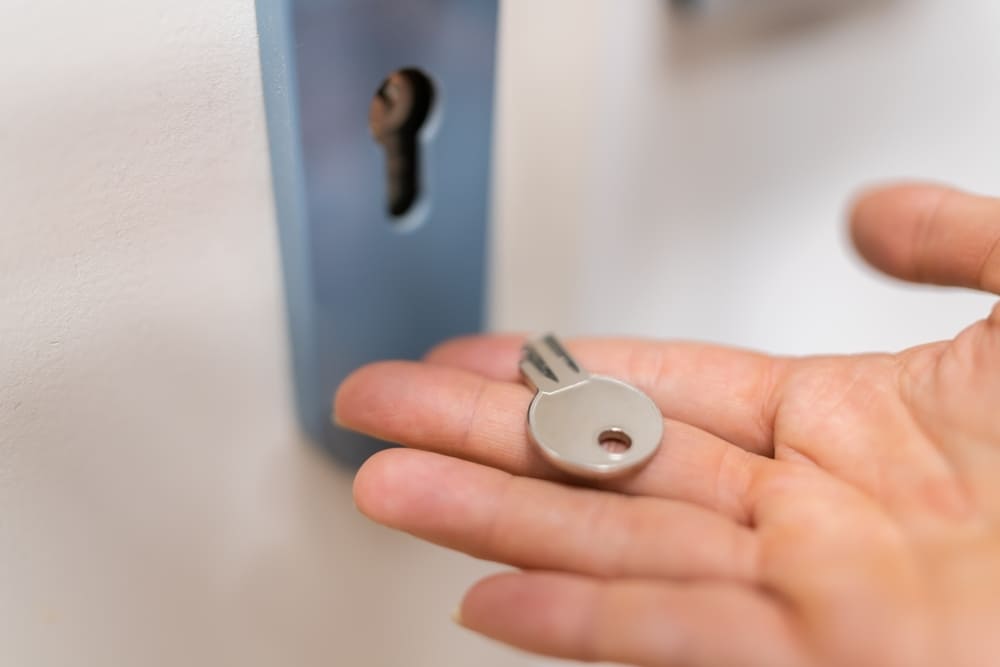
► Immediate Action to Take On Site
Before reaching for any tools, a few basic precautions reduce the risk of making things worse and improve your chances of getting the fragment out cleanly. Avoid pulling or pushing the door abruptly, particularly if it’s simply swung shut rather than been locked, since this can wedge the fragment further or block the cylinder. Don’t try to turn the broken section of the key any further inside the lock, as any movement could push the fragment deeper or damage the tumblers. Shine a torch into the lock and check whether any part of the key is visibly protruding from the cylinder, as this will decide which removal method applies.
In short: don’t force the door or the key, and check with a torch whether the fragment is visible before choosing a method.
► Tools and Materials You’ll Need
Whether the fragment is visible or lodged entirely inside the cylinder, there’s a suitable tool for each scenario. The important thing is using the right equipment, working precisely and avoiding extra strain on the lock mechanism.
The following have proved useful in practice: good lighting from a torch or head torch, a magnifying glass for inspecting the fragment’s exact position, and precision tools such as flat-nose pliers, pointed tweezers, a small flat-head screwdriver, a paper clip or a thin, flexible wire. A broken-key extractor set is worth having for fragments that sit flush with the cylinder face or are lodged deep inside. A strong magnet is useful for ferromagnetic keys only, and a light lubricant such as graphite spray or a small amount of WD-40 can help. Superglue can work in exceptional cases but should be used with caution, and fine drill bits with a cordless drill or driver are a last resort. Safety glasses and gloves are worth wearing throughout to protect against injury while working at close quarters.
In short: a torch, tweezers or pliers, and a broken-key extractor set cover most cases, with a magnet, lubricant or drill as fallback options for trickier fragments.
Extractor Sets: the Professionals’ Preferred Tool
A broken-key extractor set contains extractor blades, extractor pliers and key-removal tools designed specifically for this job. They engage with the cuts in the broken key, often allowing the fragment to come out without damaging the cylinder, which is why professionals tend to reach for this method first.
In short: an extractor set is the lowest-risk professional tool for removing a broken key, since it grips the key’s cuts directly rather than the cylinder itself.
► Removing a Visible Broken Key
If part of the broken key is still protruding, or is at least clearly visible within the keyway, there’s a good chance it can be removed manually. The aim is to loosen and extract the fragment carefully without putting unnecessary strain on the locking mechanism.
Start by illuminating the cylinder with a light source to identify the exact position and alignment of the fragment. Choose flat-nose pliers if it’s clearly visible, or tweezers for smaller, narrower pieces, and grip the fragment carefully using slow, controlled movements rather than force. A short spray of graphite lubricant or WD-40 may help loosen the fragment, but use it sparingly, since excess oil attracts dirt and can affect the lock’s operation later. Finally, gently twist or wiggle the fragment to release it, then pull it out slowly. Keep a steady hand and take your time throughout, as sudden movements could break the remaining fragment or push it deeper into the lock.
In short: with a visible fragment, light it, grip it gently with pliers or tweezers, add a touch of lubricant if needed, and work it free slowly.
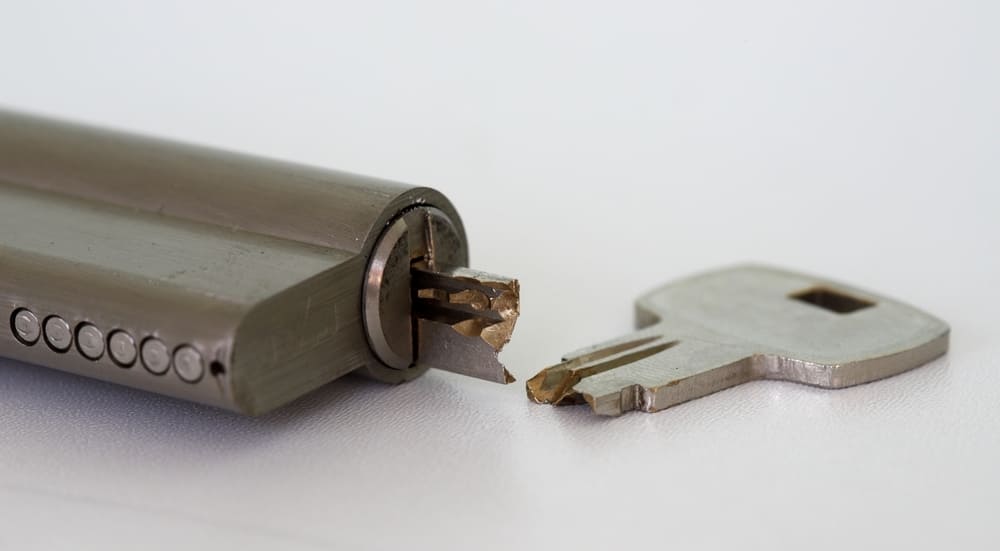
► Removing a Broken Key When the Fragment Isn’t Visible
If the fragment has disappeared completely inside the cylinder or sits flush with the face of the lock, a more precise technique is needed. The challenge is gripping the fragment without damaging the cylinder, and a few methods have proved effective.
Using a broken-key extractor
This is the professional method: carefully insert the extractor into the keyway, position it so it engages with the cuts in the broken key, then use a gentle twisting motion to pull the fragment out slowly. It has a high success rate and places minimal mechanical strain on the lock.
The superglue method
Although popular on social media, this is a genuinely risky method and should only be attempted if the end of the fragment is clearly visible. Cover the lock around the fragment with adhesive tape, apply a small drop of glue to a wooden stick, press the prepared end against the key fragment and wait a few minutes for the adhesive to cure fully before pulling the broken key out carefully. If adhesive gets into the lock mechanism, it can permanently render the cylinder unusable, so this method carries real risk and is worth trying only as a last resort before drilling.
The superglue method
Bend a piece of wire into an L shape or a small hook, insert it into the cylinder and manoeuvre it underneath the broken key, then apply gentle pulling or levering pressure to try to extract the fragment.
Using a magnet
For ferromagnetic keys containing iron, holding a strong magnet against the lock may draw the fragment out if it isn’t lodged too deeply. Many modern keys aren’t magnetic, though, and even a magnetic key will need a genuinely powerful magnet to overcome the resistance inside the lock.
In short: an extractor set is the safest bet for a hidden fragment, while superglue, wire or a magnet are viable but carry more risk of damaging the cylinder if used carelessly.
►Last Resort: Drilling and Replacing the Cylinder
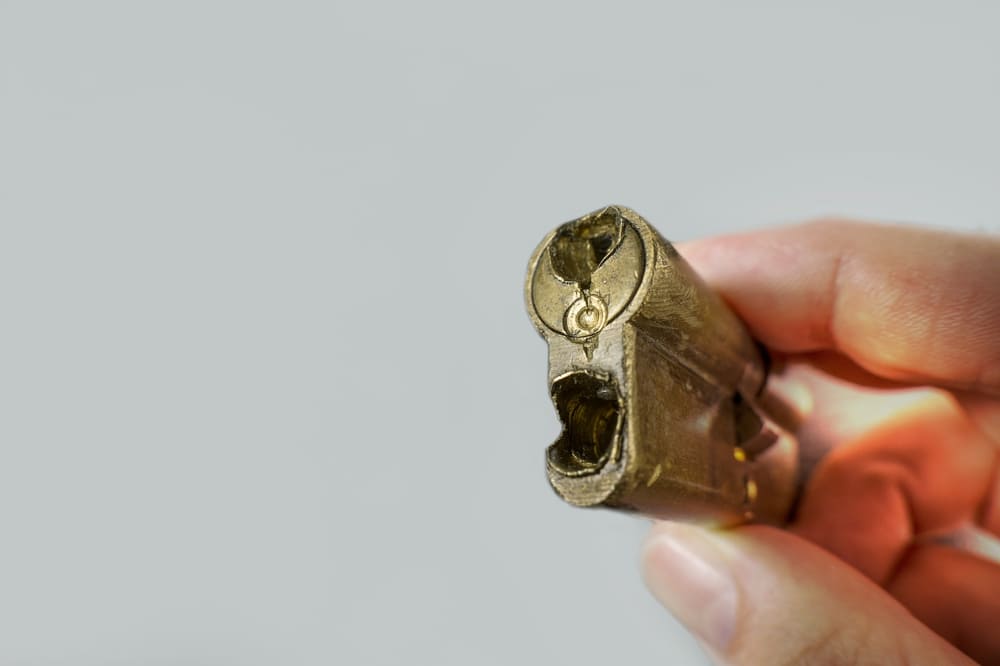
If every other method fails and access is no longer possible, the final option is to have a suitably qualified professional drill out the cylinder mechanically. This will often damage the cylinder, so it should only be considered if a replacement cylinder is readily available.
Where possible, remove the door furniture and take out the complete cylinder after loosening the retaining screw, which is only an option if the door can still be opened. Position a very fine drill bit in the centre of the keyway to loosen or break up the fragment, then use tweezers or wire to extract the loosened or broken pieces. Drilling carries genuine risks: metal swarf can fall into the lock and cause further damage, improper drilling can damage the door mechanism or surrounding components, and high-security cylinders with drill protection make removing the broken key even harder. These are risks worth weighing carefully before starting, particularly on a security-critical door.
In short: drilling is a last resort that risks further damage to the lock, and it should only be attempted by someone qualified, with a replacement cylinder ready to fit.
► When Should You Call a Locksmith?
Not every situation needs a specialist straight away, but in many cases a professional locksmith is the safest and most cost-effective route. Call one if all non-destructive removal methods have failed or the fragment is inaccessible, if the cylinder is already damaged or won’t turn, if the lock is security-critical (as part of an access control system or master key system, for example), or if uncertain or imprecise work could cause further damage. A reputable locksmith will have the specialist tools, experience and expertise to open even complex cylinder systems without causing damage.
In short: call a locksmith when the fragment can’t be reached safely, the cylinder is already damaged, or the lock is security-critical.
► Follow-up Checks and Inspection
Once the broken key fragment is out, the lock shouldn’t go straight back into use without a follow-up check to confirm it’s still fully functional. Use a spare key to test whether the cylinder turns smoothly and the locking mechanism operates correctly, and clean out any drilling dust or lubricant residue from the keyway using compressed air or a fine brush. Apply a small amount of graphite powder or specialist lock lubricant, and if the lock continues to stick or feels difficult to turn after the repair, replacement is the sensible option. For master key systems in particular, check that all associated keys still operate correctly across the wider system.
In short: test the lock with a spare key, clean and lubricate the cylinder, and replace it if it still sticks after the repair.
► Prevention: How to Avoid Broken Keys
A broken key can be a warning sign of material fatigue or another underlying problem, and targeted maintenance can prevent many failures before they happen. Keep a spare key somewhere secure, such as a safe, or with a trusted person, and inspect keys regularly for cracks, bending and wear, replacing damaged ones immediately. Lubricate locks lightly once a year using graphite or a specialist lock lubricant, and never force a key that sticks when being inserted or turned; investigate the cause instead. Cheap blanks and poorly made duplicate keys are often lower quality and more prone to breaking, so it’s worth using robust keys from a reputable source.
Metal keys are wear parts too, and deteriorate over time, particularly with frequent use. Microcracks, material fatigue and wear caused by dirt or moisture all raise the risk of a key breaking, so regular replacement is part of a sensible locking-system maintenance routine.
In short: regular inspection, light annual lubrication and good-quality keys are the main ways to avoid a broken key in the first place.
► A Systematic Approach Avoids Further Damage
A broken key inside a lock is a genuine inconvenience, but a calm, systematic approach usually resolves it. Start with the least invasive methods and use specialist tools such as a broken-key extractor set before considering anything more destructive. Begin with a visual inspection to see whether the fragment is visible or has disappeared inside the cylinder, then try non-destructive methods first, such as pliers or tweezers for a visible fragment, or an extractor set otherwise. A magnet or bent wire may offer another option, and superglue should only be used with real caution. Drilling should only be considered if the cylinder is due for replacement anyway and the person doing the work has the necessary technical expertise, and if you’re unsure at any point, or dealing with a security-sensitive keyless entry system, call a locksmith.
A Digital Locking System Removes the Risk Entirely
A digital locking system from SimonsVoss removes the risk of broken, lost or jammed keys for good. Our keyless electronic solutions replace mechanical keys with digital credentials, which means there’s no metal key left to snap, jam or wear out in the first place, and access can be granted, changed or revoked instantly instead of relying on a physical key ever going missing. For estates already running a digital master key system, the same principle applies at scale, since there’s no master key to lose or copy either.
If broken keys are a recurring headache for your building or site, get in touch to talk through what a digital locking system could look like for you.
Dealing with recurring key or access problems on your site? Get in touch to find out how a keyless system could help.
FAQ
Can a broken key always be removed without a locksmith?
Not always. A visible fragment can usually be removed with pliers, tweezers or a broken-key extractor set, but a hidden or deeply lodged fragment, a damaged cylinder, or a security-critical lock are all situations where calling a locksmith is the safer option.
Is it safe to use superglue to remove a broken key?
It carries real risk and should only be attempted if the end of the fragment is clearly visible. If glue gets into the lock mechanism, it can permanently render the cylinder unusable.
What tools do I need to remove a broken key myself?
A torch, a magnifying glass, flat-nose pliers or tweezers, and ideally a broken-key extractor set cover most situations. A magnet, light lubricant or fine drill bits are useful for trickier cases.
Should I check the lock after removing a broken key?
Yes. Test it with a spare key, clean out any residue, lubricate it, and replace the cylinder if it still sticks or turns with difficulty after the fragment is out.
How can I stop keys breaking in the future?
Keep a spare key stored securely, inspect keys regularly for wear, lubricate locks once a year, never force a sticking key, and use good-quality keys rather than cheap duplicates.
How does a digital locking system prevent this problem?
A digital locking system replaces the mechanical key with a digital credential, so there’s no key left to snap, jam or wear out, and lost or compromised access can be revoked instantly instead of requiring a physical key to be replaced.