
Lift access control is a system that manages who can call a lift and which floors they’re permitted to reach, ideally with a clear audit trail of who’s been granted access. Lifts provide a direct connection between floors, but they can also create a potential access point for unauthorised people, and lift security often gets less attention than door security as a result. Lifts play a key role in modern buildings, providing fast, convenient connections between reception areas, car parks, offices, residential floors and plant areas, and because they’re heavily used and bring different user groups together, they can quickly become a weak point in a building’s overall security strategy.
Even where the main entrance is controlled, a lift without appropriate access controls can let someone reach floors they’re not authorised to enter, simply by stepping into the lift alongside someone else, for example, and this becomes even harder to manage where offices and residential floors share the same lifts. Lift access control addresses precisely these vulnerabilities, and when implemented effectively, it needn’t complicate day-to-day operations; it can genuinely streamline them instead.
What Does Lift Access Control Do?
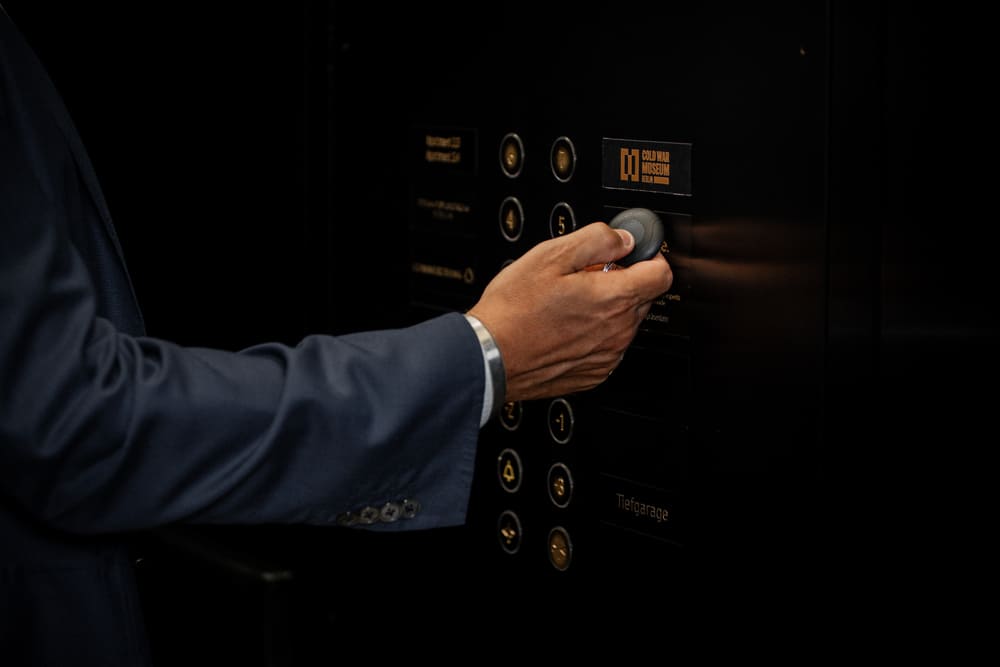
Lift access control combines hardware, such as readers, relays and control components, with software to manage access, determining who’s authorised to call a lift and which floors they’re permitted to access. Users identify themselves using a transponder, card or another electronic credential, and the system verifies their access permissions before enabling access to the predefined areas they’re authorised to use.
In short: lift access control pairs readers and control hardware with software that checks a credential and only unlocks the specific floors that person is allowed to reach.
Requirements and Objectives of Lift Access Control
► Preventing unauthorised access.
The primary objective is to reliably distinguish between authorised and unauthorised users. Depending on the building, this may mean the lift is locked by default and can only be used following successful authentication, or that users can access certain floors while others remain restricted, which prevents someone who’s reached the lobby from automatically being able to reach other floors in the building.
► Managing user access permissions.
Buildings are dynamic environments: new employees join, existing staff move between departments, contractors need temporary access, and visitors may need short-term permissions. A modern solution needs to accommodate these changing requirements quickly and at a granular level, including floor permissions based on role, such as administration, technical services, storage or tenant areas, time-based access for office hours or specific shifts, and temporary permissions for visitors, contractors and other third parties. Access permissions need to be managed within the system so changes can be implemented quickly and remain traceable.
► Improving overall building security.
A lift rarely operates as an isolated system. Effective lift access control can improve security throughout a building by restricting unauthorised movement, separating working areas more effectively and protecting sensitive zones such as IT rooms, archives and storage areas. When lifts, doors and day-to-day security processes work together, they create a consistent level of security across the building rather than a collection of disconnected solutions.
► Managing people flow and improving efficiency.
Efficiency matters particularly in large, heavily used buildings. Lift access control helps organise movement by clearly defining who can access which floors and directing visitors more effectively, reducing the administrative burden, and when processes are designed well, they can also help prevent queues at key access points.
In short: good lift access control does four jobs at once, keeping out unauthorised users, managing permissions as people and roles change, tying into wider building security, and keeping people moving efficiently.
SimonsVoss SmartRelay: The Digital Switching and Control Hub for Lifts
SimonsVoss SmartRelay units are electronic control devices that only enable technical systems, including barriers, gates, motorised locks and lifts, following successful authentication. Users authenticate with an authorised credential such as a transponder or card, and SmartRelay then enables the relevant function; certain models can also transmit data via virtual networks.
In practice, there are three possible configurations. An in-car solution installs SmartRelay 1 or 2 inside the lift car, so the user authenticates inside the lift before travel is enabled. A landing solution installs SmartRelay 1 or 2 outside the lift, so the user authenticates in the lobby or landing area before travel is enabled. A floor-specific solution combines SmartRelay 3 Advanced with a SmartOutput Module, so once authenticated, the user can select only the floors they have permission to access.
In short: SmartRelay only enables a lift, gate or barrier after successful authentication, and can be configured to check that authentication inside the car, at the landing, or per floor.
Who Benefits from Lift Access Control?
Lift access control is useful wherever large numbers of people move through a building or where different areas need clear separation, and the specific requirements vary considerably by how the building is used.
In short: the priority shifts by building type, residents in housing, zoning in mixed-use sites, department-level control in offices, and queue-free throughput in high-footfall venues.
► Multi-occupancy residential buildings.
Protecting residents is the priority here, with the aim of reducing unauthorised access and providing appropriate security for residential floors. Typical requirements include different access permissions for individual flats or tenancies, clear separation between basements, plant areas and car parks on one hand and residential floors on the other, and simple, intuitive operation without unnecessarily complicated processes.
► Mixed-use buildings.
Where residential, office, hotel, hospitality or public spaces coexist within the same building, granular access control becomes particularly important, with separate lift and floor permissions for each area of use, clear zoning between public, private and operational areas, and flexible administration to accommodate frequently changing user groups.
► Office and commercial buildings.
Here, visitors share buildings with internal staff and operational areas, so restricting access to floors containing sensitive information, specific departments or back-office areas matters particularly. Typical requirements include structured visitor management with time-limited access permissions, employee access based on role, department or location, and targeted protection for plant rooms, IT areas, archives, storage facilities and staff-only areas.
► High-footfall buildings.
In heavily used buildings such as event venues, exhibition centres, healthcare facilities and public sector buildings, security and convenience need to work together, with clear processes that help prevent queues, temporary access permissions for visitors, suppliers and contractors, and transparent access rules that remove the need for improvised workarounds.
Practical Example: Motorworld Munich
At Motorworld Munich, based in Freimann since 2021, the operator uses SimonsVoss digital locking technology for access control, aiming to protect high-value assets while providing flexible, convenient access for tenants, their teams and visitors. Environments like this typically bring together many different user groups, including visitors, event guests, employees, suppliers and contractors, while different parts of the site have very different security requirements, ranging from publicly accessible spaces to restricted operational and plant areas.
The installation includes around 600 System 3060 digital locking cylinders, 700 transponders, SmartHandle AX devices and approximately 30 SmartRelay units. SmartRelay 3 Advanced units act as switching and control hubs for data transmission within the virtual network, letting tenants use a single transponder both to enter the building and to access specific areas, such as their glass-fronted units. SmartOutput Modules also integrate additional functions, including lift controls, the post-box system and the glass-fronted units.
In short: Motorworld Munich runs around 600 cylinders, 700 transponders and 30 SmartRelay units on one system, letting a single transponder cover building entry, specific tenant areas and lift access together.
Benefits of Well-Designed Lift Access Control
Lift access control delivers the greatest value as part of a coherent, building-wide security strategy. Unauthorised users can’t access floors requiring a higher level of protection, which helps reduce risks such as theft, vandalism and unwanted encounters in sensitive areas, and modern systems provide fast, intuitive authentication without the familiar problems of conventional keys, such as loss, unauthorised duplication, and time-consuming issue and administration. Floor permissions and time profiles can be assigned and adjusted precisely, which is particularly valuable in properties with multiple user groups, frequent personnel changes and temporary access requirements, and lift control becomes part of a wider strategy in which access, building operations and security are managed as a coherent whole rather than separately.
In short: well-designed lift access control protects sensitive floors, removes key-related friction, and lets permissions be managed precisely, all as part of one joined-up building security strategy.
How to Implement Secure Lift Access Control
Effective lift access control is a key component of modern building security, and in many properties lifts have a significant impact on who can reach sensitive parts of the building, yet their access controls are still too often overlooked. Careful planning can substantially reduce these risks without making building operations more complicated.
Don’t treat the lift as an isolated system. Consider it as part of the building’s overall access control strategy, alongside external and internal doors, floor-by-floor zoning, visitor management and clearly defined processes for contractors, all working together. The result is a consistent level of security rather than a series of disconnected solutions, and crucially, your lift access strategy needs to reflect how the building actually operates, from straightforward access permissions through to granular floor-by-floor authorisation. Clear responsibilities and well-defined processes help prevent security gaps from developing over time.
In short: treat the lift as part of the building’s wider access control strategy from the outset, not as a separate system bolted on afterwards.
Interested in implementing access control for your lifts? Get in touch and we’ll help you select and implement the right SimonsVoss solution for your requirements.
FAQ
What does lift access control actually control?
Which floors a person can reach, not just whether they can enter the lift, using a transponder, card or other electronic credential checked against their access permissions.
What is SimonsVoss SmartRelay?
An electronic control device that only enables technical systems such as barriers, gates, motorised locks and lifts after successful authentication, available in in-car, landing and floor-specific configurations.
Can lift access permissions be time-limited?
Yes. Permissions can be set for specific office hours or shifts, and temporary access can be granted to visitors, contractors and other third parties without giving them permanent access.
Why is lift access control particularly important in mixed-use buildings?
Because residential, office, hotel or public spaces sharing the same lifts need separate floor permissions and clear zoning between public, private and operational areas to stay secure.
How does lift access control fit into wider building security?
It works best as part of a single, coherent strategy that includes external and internal doors, visitor management and contractor processes, rather than being managed as a standalone system.
How many doors and transponders were involved in the Motorworld Munich installation?
The installation includes around 600 System 3060 digital locking cylinders, 700 transponders, SmartHandle AX devices and approximately 30 SmartRelay units.