
Key management is the systematic process of organising, issuing and tracking keys within an organisation, so that security is maintained and access control operates smoothly.
It’s a fundamental part of any building’s security infrastructure and involves far more than simply storing keys, since effective key management is a discipline in its own right, covering everything from who holds which key to how quickly a lost one can be dealt with. This article looks at the methods used to implement key management well, alongside the modern technological solutions now available and what they add over a purely physical approach.
The Fundamentals of Effective Key Management
Effective key management does more than secure physical access. It also ensures access permissions are managed accurately and that security procedures are followed consistently, protecting valuable assets and helping maintain a secure environment overall. This relies on clear identification and meticulous record-keeping: every key should be fully accounted for and continuously tracked in a detailed inventory, and each key should be uniquely identifiable to avoid confusion and ensure reliable traceability.
In short: effective key management rests on a detailed, continuously updated inventory where every key is uniquely identifiable, not just a general sense of who has what.

Security Considerations: How Secure Are Your Keys, Really?
Effective key management is all about attention to detail, from ensuring keys are issued to the right people to maintaining an accurate record of every instance of access, so a structured approach is essential rather than an informal one. Robust access control ensures only authorised individuals have access to keys, using measures such as electronic key management systems, biometric readers or PIN-based authentication. Comprehensive audit trails record key usage in detail where required, making it possible to track and analyse access patterns and identify unusual activity, while secure key storage and clearly defined procedures help protect against loss, theft and misuse by preventing unauthorised access and reducing the risks tied to lost or stolen keys.
In short: real key security combines controlled issuing, a detailed audit trail and secure storage, since any one of the three on its own leaves a gap.
Key Issue and Return
The process of issuing and returning keys is a cornerstone of effective key management, and it needs to be well organised to prevent misuse and avoid inadvertent security vulnerabilities. Maintaining accurate records of both issue and return is essential to preserving the integrity of the overall security system. Before a key is issued, the recipient should be properly verified so only authorised individuals receive keys, checking not just identity but their authorisation for specific areas, and adjusting access permissions where necessary. Keys also need to be returned to the correct location on time, with a clear record of their return, since lost or unreturned keys can compromise the security of the entire building or site.
In short: issuing and returning keys need the same rigour as the keys themselves, since a gap in either record can undermine the whole system.

Technological Solutions for Key Management
Digitalisation has transformed key management, and digital systems can significantly improve both administrative efficiency and security. Electronic key management automates administrative processes, extends functionality and improves transparency by maintaining comprehensive records of access events, making the whole process considerably easier to run day to day. Modern access control systems combine physical and digital security, using technologies such as biometric authentication and RFID to provide convenience alongside precise control over who can access which areas and when, adding an extra layer of security for sensitive areas. Software-based key management provides a central platform for managing access permissions, enabling efficient administration and audit logging, and can integrate with other security systems already in use.
In short: digital key management automates tracking, adds precise access control through RFID or biometrics, and centralises administration through dedicated software.
Benefits of Digital Key Management
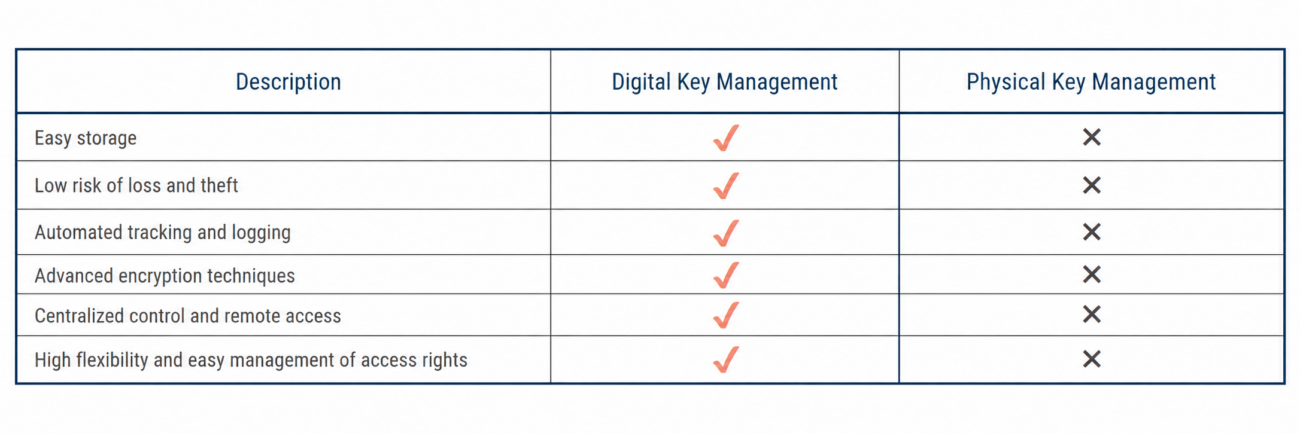
A comparison between physical and digital key management reveals significant differences in security, efficiency and flexibility. Mechanical locking systems require physical keys to be stored and managed carefully, and by their very nature keys are vulnerable to loss and theft, while tracking and administering them can be time-consuming and involve a significant amount of manual work.
Digital key management addresses these gaps directly. Automated tracking and audit logging give greater transparency over key and credential usage, with transactions and access events recorded automatically rather than by hand. Advanced encryption lets digital credentials use sophisticated technologies to strengthen security and protect the integrity of the locking system, and centralised management allows access to be managed centrally and, depending on the system architecture, remotely too. This simplifies day-to-day administration and makes it possible to adjust access permissions quickly whenever requirements change.
In short: digital key management replaces manual tracking and vulnerable physical keys with automated logging, stronger encryption and centralised, sometimes remote, control.
Key Management Best Practices
Effective key management relies on established practices that support both security and reliable day-to-day operation. Regular audits should review all keys at intervals, confirming they’re accounted for, operational and in suitable condition, which helps ensure keys haven’t gone missing and that unexpected security vulnerabilities don’t develop unnoticed. Security policies need keeping up to date too, since threats and technologies are constantly evolving, so procedures should be reviewed and updated regularly to reflect current security requirements and address emerging risks effectively. Ongoing staff training matters just as much, since as risks and technologies evolve, staff awareness becomes increasingly important, and regular training helps employees understand current threats and stay familiar with the procedures for handling and managing keys securely.
In short: best practice combines regular audits, policies that keep pace with new threats, and staff training that’s ongoing rather than a one-off induction exercise.
Conclusion: A Robust Security Strategy Needs Effective Key Management
Future developments in key management are likely to bring even greater integration with digital security systems, supported by advanced encryption and automated management processes. As a long-standing name in this field, SimonsVoss continues to develop digital locking systems and digital master key systems designed to meet these evolving security requirements.
Want to explore how digital key management could work for your organisation? Get in touch, or visit our locking systems glossary to find out more about the terminology behind modern locking solutions.
FAQ
What is key management?
Key management is the systematic process of organising, issuing and tracking keys within an organisation, to maintain security and ensure access control operates smoothly.
What makes key management effective?
A detailed, continuously tracked inventory with unique identification for every key, combined with robust access control, comprehensive audit trails, and secure procedures for issuing, returning and storing keys.
How is digital key management different from physical key management?
Digital systems automate tracking and audit logging, use advanced encryption to protect credentials, and allow access to be managed centrally and, depending on the system, remotely, rather than relying on manual records and physical keys that can be lost or stolen.
What technologies are used in digital key management?
Electronic key management systems, biometric authentication, RFID-based access control and software platforms that centralise permissions and audit logging.
How often should keys be audited?
Keys should be reviewed at regular intervals to confirm they’re accounted for, operational and in suitable condition, as part of ongoing best practice rather than a one-off check.
Why does staff training matter for key management?
Because security risks and technologies keep evolving, regular training helps staff understand current threats and stay familiar with the correct procedures for handling and managing keys securely.